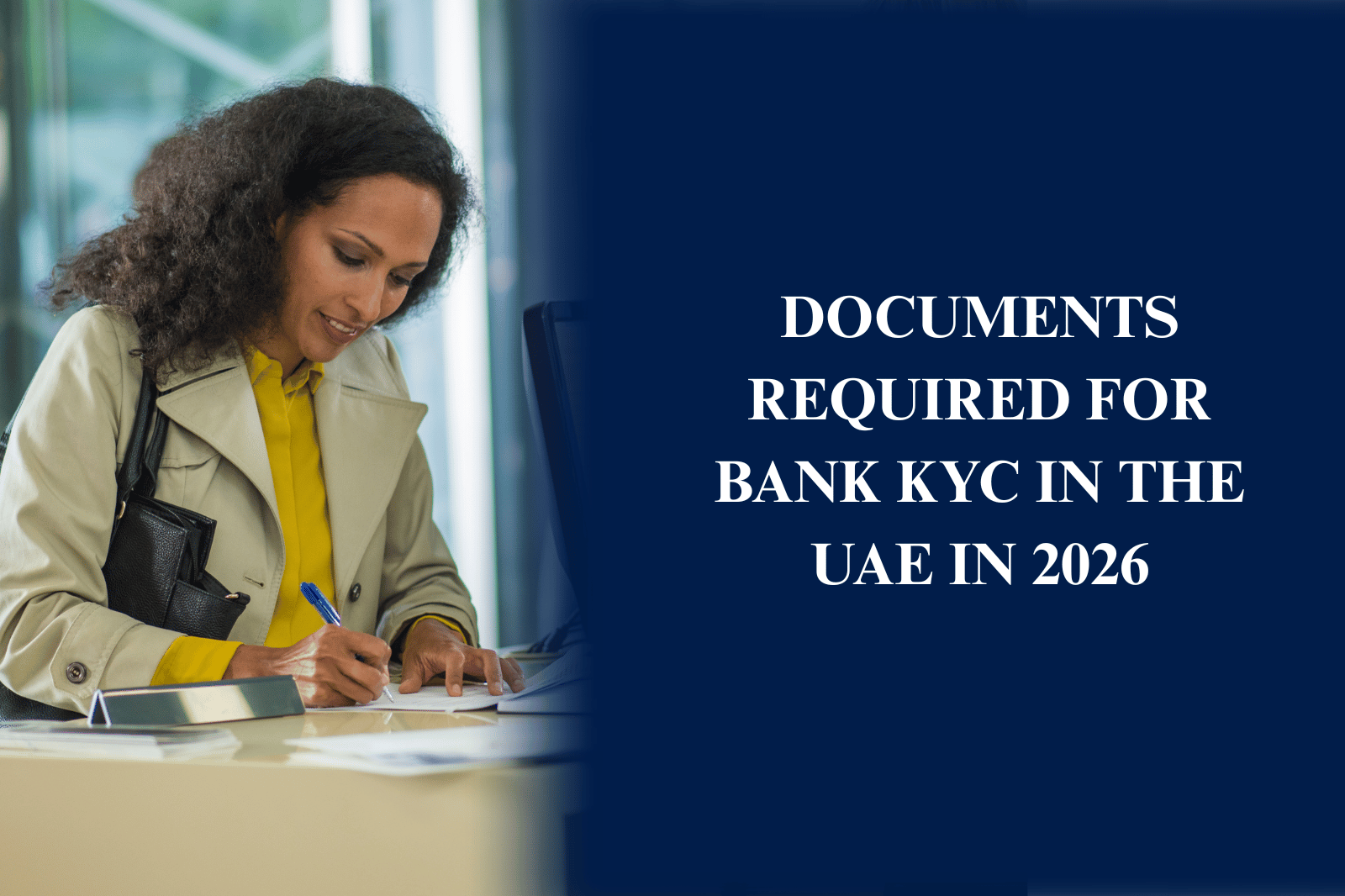


Documents Required for Bank KYC in the UAE in 2026 have become an important part of opening a business bank account. Before completing the KYC process, banks in UAE require precise information concerning the company, its owners, sources of funds, and its dealings. The trade licence may not be adequate since banks tend to ask for many other documents while performing compliance checks.
KYC, or Know Your Customer, enables banks to verify the individuals that own and run a business and how the business intends to utilize the account. Therefore, business owners must have the company records, shareholder information, details of the UBO, business documents, financial details, and compliance documents at hand when applying for banking services. Proper preparation will help extricate the process in a timely manner without delays that may arise due to gaps in information.
Why Is KYC Important for UAE Business Bank Accounts?
KYC serves as a compulsory compliance procedure for banks in the UAE to verify the identity of clients and obtain information about their businesses. Banks assess all the information provided by companies with regard to UAE regulation laws and international compliance laws. KYC for banks involves checking the three basic information categories about companies:
- Company Ownership
- Company Activities
- Source of Funds
KYC at banks has developed together with anti-money laundering (AML), counter-terrorism financing (CTF), FATCA, and CRS requirements. Thus, applicants can expect their banks to ask for more than just basic corporate registration documents.
Complete UAE Business Bank Account KYC Document Checklist
Although there may be differences in the requirements of a bank as well as those of a business structure, according to the source there are a few categories of documents that have to be prepared by businesses to go through the KYC accuracy process required by the banks.
| Document Category | Common Documents | Main Purpose |
| Company Documents | Trade License, Certificate of Incorporation, MOA, AOA, Share Certificates, Office Address Proof | Verify the company’s legal existence |
| Shareholder Documents | Passports, Emirates ID, UAE Visa, Residential Address Proof | Verify owners and authorised signatories |
| UBO Documents | UBO Declaration, Ownership Structure Chart, Beneficial Owners’ Passports | Identify ultimate beneficial owners |
| Business Activity Documents | Company Profile, Business Plan, Website, Contracts, Invoices | Understand the business model and activities |
| Source of Funds Documents | Bank Statements, Salary Certificates, Investment Proof, Sale Agreements | Verify the origin of business capital |
| Compliance Documents | FATCA Form, CRS Declaration, PEP Declaration | Meet regulatory and international compliance requirements |
Company Documents Required for KYC
Corporate documents are essential for the opening of a business bank account. The banks require the documents in order to ascertain that the organization is legally in existence as well as to check what the registered structure and activities of the organization are. Common company documents include:
- UAE Valid Trade License
- Certificate of Incorporation
- Memorandum of Association or MOA
- Articles of Association or AOA
- Share certificates
- Proof of corporate office address
The bank can use these documents to cross-check the information in the documents by comparing the details of the business organization.
Shareholder and Signatory Documents
The banks would like to check the people that are running or controlling the business. For that purpose, the shareholders and authorized signatories would have to submit their identification documents during the KYC process. The documents may be as follows:
- Passport copies
- Emirates ID, if applicable
- UAE residence visa
- Proof of residential address
UBO Documents for UAE Banks
UBO stands for Ultimate Beneficial Owner. Financial institutions keep an eye on the UBO aspects as they need to ascertain who owns or controls the company on the whole. As per the source, UBO means the one owning directly or indirectly 25% and more of the company. Banks typically require:
- UBO Declaration Form
- Copies of passport of beneficial owners
- Shareholding Certificates
- Ownership Structure Chart
- Parent Company Documents, if applicable.
Companies having many shareholders or more than one layer of ownership must carry on experience diligence. Hence, any business dealing with the parent firm or overseas companies must keep its ownership documents in order.
Ownership Structure Chart
A neat ownership structure chart can help the bank to see the flow of ownership within the company. It becomes specifically useful when the firm is holding shares of another company or if more than that one entity is involved. The chart should display.
- Ownership structure of the company
- Percentages of shareholdings
- Beneficial owners
- Parent company, if applicable
When clear instructions are given, it helps the compliance team to get hold of UBO readily.
Business Activity Documents
Before availing of a corporate account, banks must comprehend the operations of a business. The trade license gives evidence regarding the activities of the business. The banks may require additional documents to verify the business model. Business activity documents can comprise of:
- Company Profile
- Business Plan
- Company Website
- Contracts
- Invoices
The above mentioned documents help banks to understand the business of a company better.
Company Profile and Business Plan
A company profile gives the banks necessary details about business. Its explanation of the products, customers, and activities of a company is useful. A business plan provides more details regarding the operations and earning of revenue by the company. The information is essential especially for a newly formed business to clarify the purpose of its bank account.
Contracts and Invoices
Contracts and invoices are examples of documents that provide evidence of the economic activities of a company. They show the existence of its commercial activity in connection with the activities mentioned in the business documentation. For example, contracts can show the existence of the relationship with customers and suppliers of the company. Furthermore, invoices can be considered as proof of the economic transactions.
Source of Funds Documents
UAE banks must ensure that the money that goes into the business account has a transparent source. Source of funds documents serve to provide information regarding the source of the money that will be utilized by the business. Depending on the situation surrounding the applicant, the bank may request the following documents:
- Personal bank statement
- Salary certificate
- Evidence of investment
- Sale contracts
Providing these documents will give the bank a better understanding of how the company’s funds were obtained.
Personal Bank Statements
Personal bank statements can play a big role in determining the financial history of a business person investing in the company. The bank may analyze the deposit statements to identify where the money being deposited comes from. Therefore, it is recommended to provide documents that confirm what is said during the KYC process.
Salary Certificates
Salary certificates may be used as proof of salary for the applicant. The documents may be combined with other financial documentation in order to understand the source of the applicant’s funds. The specific documents necessary can differ from bank to bank depending on the person’s circumstances.
Investment Proof and Sale Agreements
Investment proofs indicate the receipt of funds from investments, and sale agreements evidence funds received from the sale of an asset or business. Banks may ask for such proofs when investors make use of their investment earnings or sales proceeds. The documentation in question must clearly link the funds to their source.
Compliance Declarations from UAE Banks
The KYC process also requires several compliance declarations. Banks might ask applicants to fill up certain documents to comply with regulatory standards in the UAE and abroad. Common declarations include:
- Politically Exposed Person Declaration
- FATCA Self Certification
- CRS Self Certification
- Various other information important in compliance audits
Each declaration is intended to obtain different pieces of information to help the bank assess the compliance profile of the client.
PEP Declaration
A Politically Exposed Person or PEP declaration is instrumental in identifying if any applicant is affiliated with a public office, which is how banks apply the information in their compliance and risk assessment processes. Accuracy is paramount in filling out the declaration.
FATCA Self Certification
A Politically Exposed Person or PEP declaration is instrumental in identifying if any applicant is affiliated with a public office, which is how banks apply the information in their compliance and risk assessment processes. Accuracy is paramount in filling out this declaration.
CRS Self Certification
CRS means Common Reporting Standard through which banks can ascertain the tax residency of customers for international reporting. The information given in the declaration fulfills a part of the bank’s compliance process.
Sanctions Screening During KYC
As part of the compliance checks, banks also perform sanctions screening. The screening is generally performed in-house but the bank can also ask for extra details from the applicant in exigency. If there is a necessity to provide further information while the bank is reviewing the application process, the applicant must be clear in communicating the same.
How to Prepare Your KYC Documents
Getting ready the documents ahead of applying to the bank makes the application for the business account easier as it is better organized and structured. The best way to begin is to gather together business documents, personal ID documents, data on ownership, documents on the business activity, fiscal documents, and compliance papers. A practical preparation checklist includes:
- Gather all up-to-date business registration documents.
- Prepare documents confirming identities of the owners and signatories of the business.
- Generate a complete ownership structure.
- Gather documents giving evidence of the activity of the company.
- Prepare proof of funds.
- Complete all compliance forms.
- Make sure the information is consistent across documents.
Importance of Completed Documentation
Missing documents can raise questions when the bank is examining the business. Missing or vague information regarding ownership of business or nature of its activity may trigger additional inquiries. Fully completed KYC documents enable the bank to secure complete information regarding the nature and activity of the business, its owners, and the source of funds. Thus, it is wise to prepare the necessary documents before applying for the account.
What If the Business Has a Complex Ownership Structure?
Companies having numerous stakeholders, parent organizations, or entities from other countries may require additional information about the ownership. In case the ownership structure has more than one level, banks may carry out the additional due diligence. In such cases, applicants should prepare:
- Full ownership structure diagram.
- UBO Declarations.
- Shareholding records.
- Copies of beneficial owners passports.
- Documentation about the parent company (if any).
The correct documentation will help the bank understand the ownership structure and define all the ultimate beneficial owners.
Common Mistakes to Avoid During KYC
Companies can minimize unnecessary back-and-forth by checking their documents in advance. The applicants must check that their financial, ownership, business, and info on shareholders do not contradict each other across different documents. It is necessary to make sure that the applicant does not submit:
- Incomplete company documents
- Unclear ownership data
- Unsupported sources of funds
- Inconsistent business information
- Missing compliance declarations
UAE Business Bank Account KYC Documents at a Glance
The KYC process becomes easier to understand when the required information is grouped by purpose.
| KYC Area | What the Bank Wants to Understand |
| Company documents | Whether the business legally exists |
| Shareholder documents | Who owns and operates the company |
| UBO documents | Who ultimately benefits from or controls the business |
| Business documents | What the company does |
| Financial documents | Where the business funds come from |
| Compliance forms | Whether regulatory requirements are satisfied |
The exact list can vary according to the bank, company structure, ownership, and business profile. Therefore, applicants should check the requirements of their chosen bank before submitting documents.
Conclusion
Documents Required for Bank KYC in the UAE in 2026 cover company records, shareholder identification, UBO information, business activity evidence, source of funds, and compliance declarations. By anticipating these needs beforehand, businesses can avoid unnecessary time losses. Detailed authentic documentation assists in entertaining banking authorities in achieving their KYC tasks more efficiently.