


From 1 October 2026, a valid tax invoice is no longer enough to recover input VAT in the UAE. Businesses now have to show that they checked both the supplier and the supply before deducting the tax. The new requirements come from FTA Decision No. 13 of 2026, and they arrive alongside wider changes to the VAT Executive Regulation under Cabinet Decision No. 149 of 2026.
This guide explains what has changed, which of your suppliers are affected, and what your finance team should do now to protect its input tax claims.
What has changed in UAE VAT from 1 October 2026?
Two sets of changes take effect together:
- FTA Decision No. 13 of 2026 sets out the measures, procedures and conditions a taxable person must follow to verify that a supply is valid and genuine before deducting input tax.
- Cabinet Decision No. 149 of 2026 amends the VAT Executive Regulation. It changes the rules on composite supplies, employee-related costs, healthcare goods, cash payments, the Profit Margin Scheme, the Capital Asset Scheme and input tax apportionment.
Both build on the amendments to the UAE VAT Law that took effect on 1 January 2026 under Federal Decree-Law No. 16 of 2025. Among other things, those amendments allow the Federal Tax Authority (FTA) to refuse input tax recovery where a supply is linked to tax evasion and the recipient knew, or should have known, about it.
Why “know your supplier” now matters for input VAT
Until now, most businesses treated input VAT recovery as a documentation exercise: hold a valid tax invoice, pay the supplier, and claim the tax. That approach is no longer sufficient.
Under the new rules, the FTA expects you to show that you took reasonable care to confirm your supplier is a real business making a real supply. If you cannot show that care, the FTA may deny the input tax on that purchase. If you actually knew the supply was connected to tax evasion, denial is mandatory.
The practical risk is significant. Losing recovery on a large purchase can cost far more than a fixed administrative penalty, because the full 5% VAT on that purchase becomes a cost to your business.
The thresholds: which suppliers need checking?
The level of checking depends on the value of each supply and on your total purchases from that supplier over a rolling 12-month period. All amounts exclude VAT.
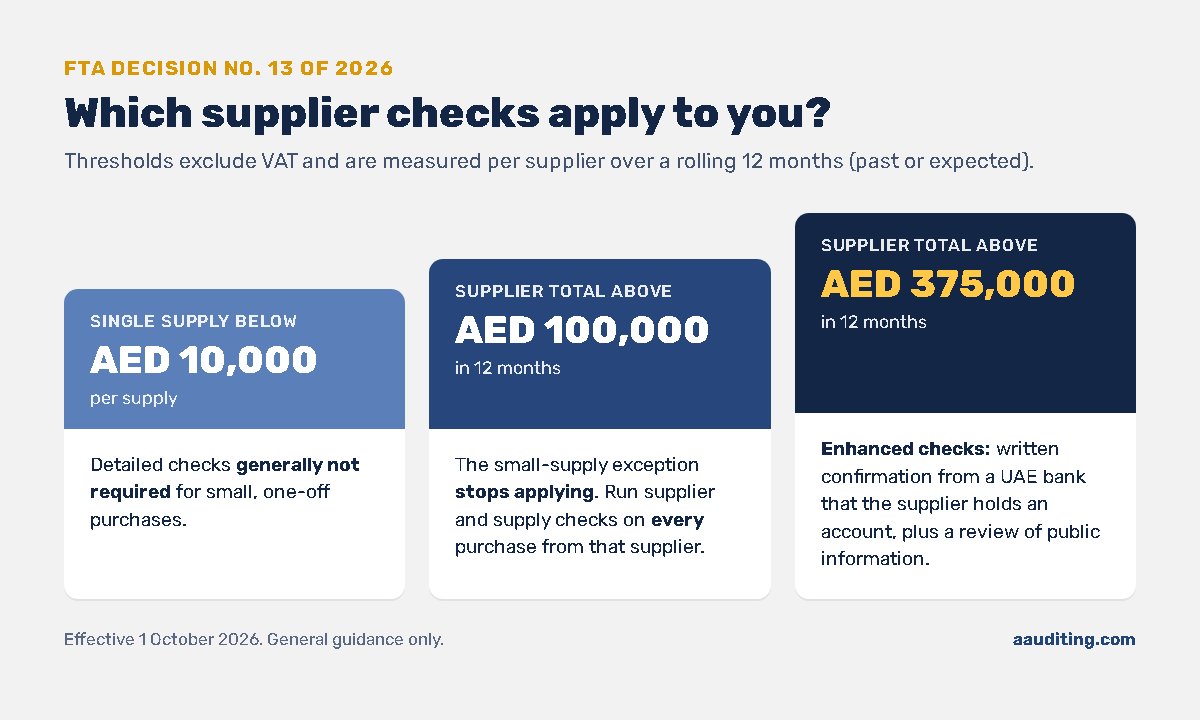
| Threshold (excluding VAT) | What it measures | What you need to do |
|---|---|---|
| Below AED 10,000 | A single supply | Detailed checks are generally not required for the individual purchase. |
| Above AED 100,000 | Total supplies from one supplier in the past 12 months, or expected in the next 12 months | The small-supply exception stops applying. Carry out the full supplier and supply checks. |
| Above AED 375,000 | Total supplies from one supplier in the past 12 months, or expected in the next 12 months | Enhanced checks also apply, including written bank confirmation and a review of public information. |
Note the forward-looking test. If you expect purchases from a new supplier to cross AED 100,000 or AED 375,000 in the coming year, the higher level of checks applies from the start of the relationship.
Step 1: Verify the supplier
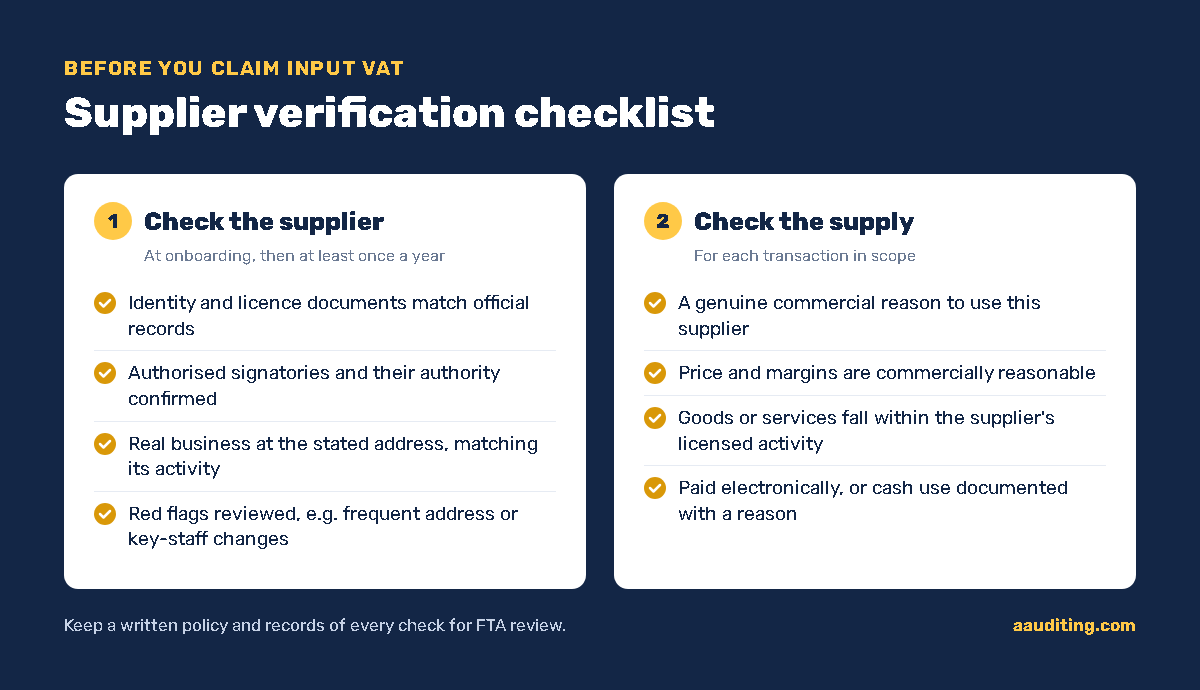
Supplier checks should be carried out when you onboard a supplier and repeated at least once a year. They include:
- Identity and licensing: confirm the supplier’s trade licence, Tax Registration Number (TRN) and other identity documents against official records.
- Authorised representatives: confirm who is authorised to act for the supplier and the scope of their authority.
- Genuine operations: confirm the supplier actually operates from its stated address and that its business matches its declared activity.
- Risk indicators: look out for warning signs, such as a supplier whose address or key personnel change more than twice within 12 months, or transaction volumes that are out of proportion to the size of the business.
Enhanced checks above AED 375,000
Where purchases from one supplier exceed, or are expected to exceed, AED 375,000 over 12 months, you must also:
- obtain written confirmation from a bank licensed in the UAE that the supplier holds an account, without reservations or conditions; and
- review publicly available information about the supplier, such as media coverage and its reputation in the market.
Step 2: Verify each supply
Checking the supplier is only half of the requirement. For each transaction in scope, you should also be able to show that:
- there is a genuine commercial reason for buying from this supplier;
- the price and margins are commercially reasonable;
- the goods or services fall within the supplier’s licensed activity;
- the origin and ownership of goods are sound; and
- where intermediaries are involved, their role makes commercial sense.
Payment method also matters. Electronic payments are strongly preferred. If you pay in cash, record the business reason for doing so. Separately, the amended Executive Regulation allows input VAT to be denied where consideration above a threshold is paid in cash. The FTA has not yet set that threshold.
Keep a written policy and evidence of every check
The decision requires more than doing the checks. You must also be able to prove you did them. In practice, this means:
- A documented verification policy that names who carries out the checks, who reviews them and who supervises the process, along with their responsibilities.
- Records of each check, including copies of licences, TRN confirmations, bank letters and notes of any red flags and how they were resolved.
- Records kept ready for FTA review, so they can be produced quickly during a tax audit or a refund review.
Other VAT changes under Cabinet Decision No. 149 of 2026
The amended Executive Regulation also affects several other areas that finance teams should review:
- Employee-related costs: tighter conditions for recovering VAT on employee expenses, with greater FTA discretion to set those conditions.
- Composite supplies: refined rules on when several elements are treated as a single supply for VAT purposes.
- Cash payments: input VAT may be denied on cash payments above a threshold that the FTA has yet to set.
- Healthcare goods, the Profit Margin Scheme and the Capital Asset Scheme: updated rules for businesses that rely on these provisions.
- Input tax apportionment: the method for recovering residual input tax moves from an input-based to an output-based approach. This applies from the first tax year starting after 1 October 2027, so there is time to prepare, but systems may need to change.
What UAE businesses should do now
- Map your suppliers against the thresholds. Pull 12 months of purchase data and identify every supplier above AED 100,000 and AED 375,000. Include expected spend for new or growing suppliers.
- Write your verification policy. Assign responsibility for performing, reviewing and supervising checks.
- Update supplier onboarding. Add licence, TRN, authorised-signatory and address checks to your onboarding forms, and request bank confirmation letters from high-value suppliers.
- Build an annual review cycle. Re-check existing suppliers at least once a year and whenever risk indicators appear.
- Review cash and employee expenses. Reduce cash payments to suppliers and tighten your expense policy.
- Plan for the 2027 apportionment change. If you make both taxable and exempt supplies, model the effect of the output-based method on your recovery rate.
How Al Riyady Auditing can help
Our VAT team helps UAE businesses put the new requirements into practice. We can review your supplier base against the thresholds, draft your verification policy, design onboarding and annual review procedures, and run a health check on your recent input tax claims before the FTA does.
Explore our VAT consultancy services, or contact our team to discuss how the new rules affect your business. If you are also reviewing your wider tax position, see our corporate tax consultancy and accounting services.
Frequently asked questions
When do the new UAE input VAT verification rules start?
FTA Decision No. 13 of 2026 and Cabinet Decision No. 149 of 2026 take effect on 1 October 2026. The change to the input tax apportionment method applies from the first tax year starting after 1 October 2027.
Is a valid tax invoice still enough to claim input VAT?
No. You still need a valid tax invoice, but you must also be able to show that you carried out reasonable checks on the supplier and the supply. Without that evidence, the FTA may deny the input tax.
Do I need to check every supplier?
Single supplies below AED 10,000 (excluding VAT) generally do not need detailed checks. That exception stops applying once your purchases from one supplier exceed, or are expected to exceed, AED 100,000 over 12 months. Enhanced checks apply above AED 375,000.
What is the AED 375,000 bank confirmation requirement?
Where purchases from one supplier exceed, or are expected to exceed, AED 375,000 over 12 months, you must obtain written confirmation from a bank licensed in the UAE that the supplier holds an account, without reservations or conditions.
What happens if I do not carry out the checks?
The FTA may refuse your input VAT deduction on the affected supplies. Where you knew a supply was connected to tax evasion, refusal is mandatory. Because the full VAT on the purchase becomes a cost, this can be more expensive than a fixed penalty.
This article is for general information only and does not constitute tax advice. Rules and FTA guidance may change. Please speak to a qualified adviser about your specific circumstances. Source: FTA Decision No. 13 of 2026, Federal Tax Authority.